My research interests include AI agents, large language models, and graph foundation models. I am interested in learning systems that reason over structured information and interact with complex environments. My previous work explores graph structure learning, heterogeneous graphs, and multi-domain graph learning.
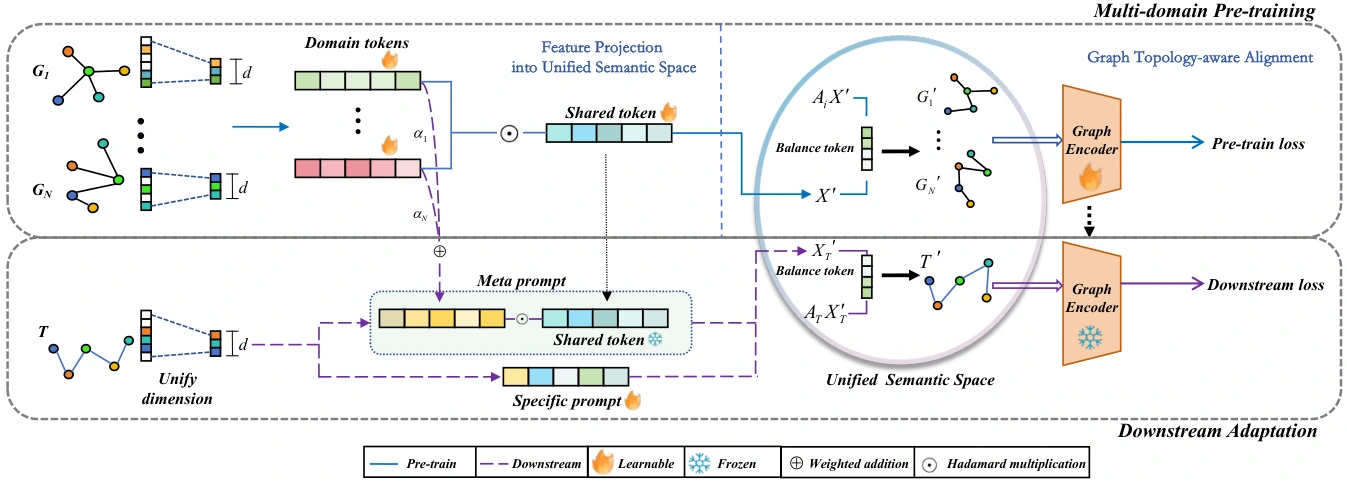
MDGFM combines feature alignment, adaptive weighting of attributes and topology, and graph refinement during self-supervised pre-training. A dual-prompt adaptation stage transfers the resulting representations to unseen domains with few labels. The work studies both transfer performance and resilience to unreliable graph connections.
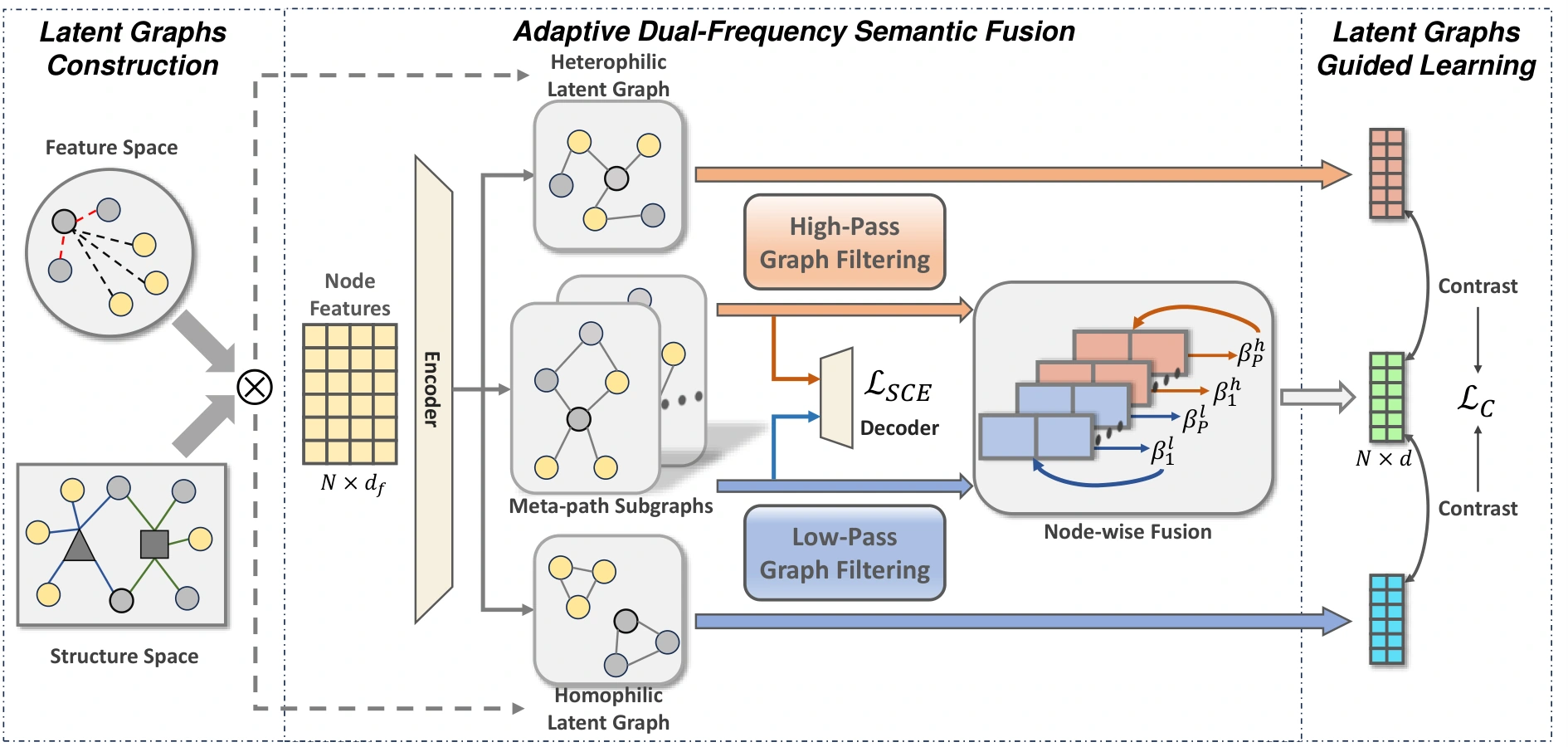
LatGRL examines semantic heterophily in heterogeneous graphs. It mines latent graphs using structural and attribute similarities, then combines low- and high-frequency information to adapt to individual nodes. The framework learns without labels and includes a scalable implementation for larger graphs.
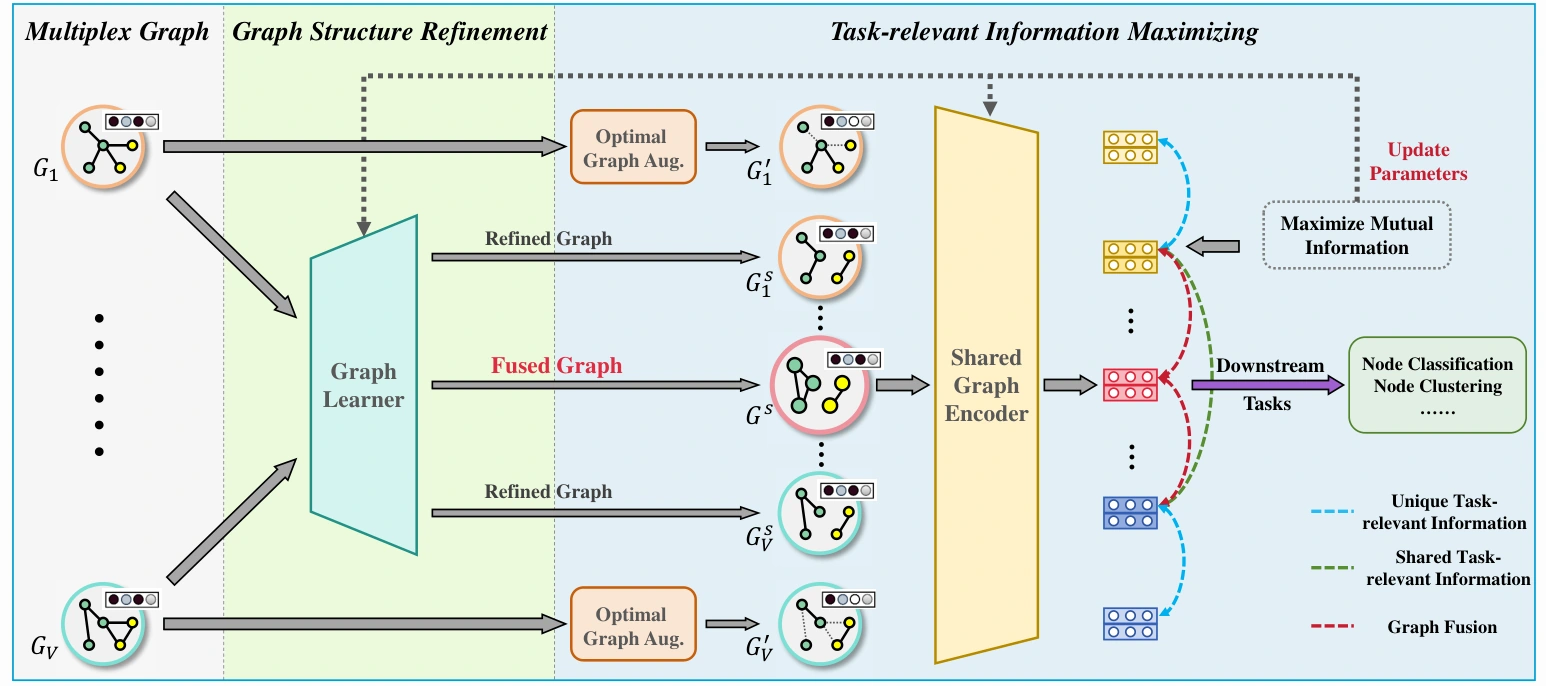
InfoMGF studies multiplex graphs whose different views contain useful information beyond their common signal. It learns refined graph structures and a fused graph, balancing shared and view-specific information while reducing irrelevant connections. The work evaluates the learned graph through downstream tasks and robustness experiments.
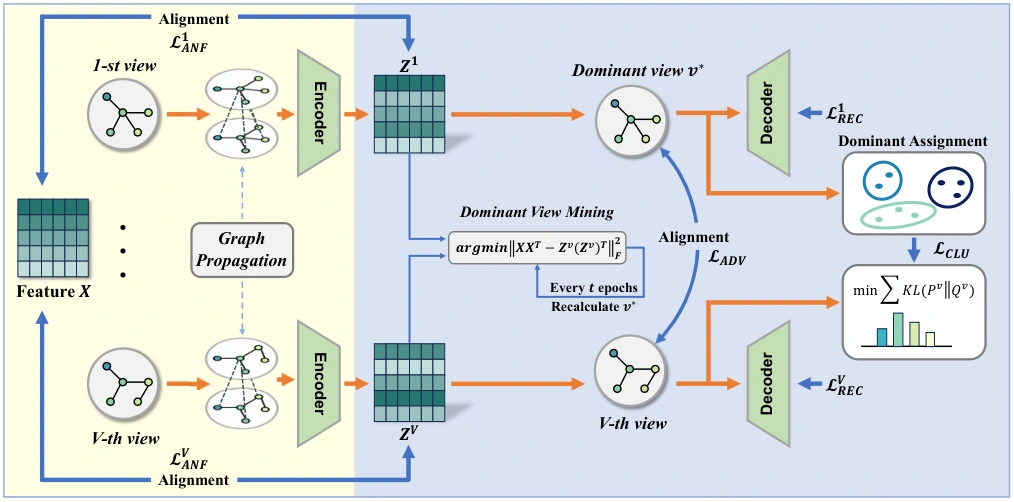
BMGC addresses unequal view quality in multi-relational graph clustering. An unsupervised procedure identifies a dominant view during training, and two complementary signals guide representation learning. A graph-quality metric connects structural differences to clustering behavior, with analysis on real and synthetic graphs.
IEEE Transactions on Pattern Analysis and Machine Intelligence (TPAMI)
IEEE Transactions on Neural Networks and Learning Systems (TNNLS)
IEEE Transactions on Circuits and Systems for Video Technology (TCSVT)
@inproceedings{wang2025multidomain,
title = {Multi-Domain Graph Foundation Models: Robust Knowledge Transfer via Topology Alignment},
author = {Wang, Shuo and Wang, Bokui and Shen, Zhixiang and Deng, Boyan and Kang, Zhao},
booktitle = {Proceedings of the 42nd International Conference on Machine Learning},
series = {Proceedings of Machine Learning Research},
volume = {267},
pages = {64806--64821},
year = {2025},
publisher = {PMLR},
url = {https://proceedings.mlr.press/v267/wang25dj.html}
}@article{shen2025heterophily,
title = {When Heterophily Meets Heterogeneous Graphs: Latent Graphs Guided Unsupervised Representation Learning},
author = {Shen, Zhixiang and Kang, Zhao},
journal = {IEEE Transactions on Neural Networks and Learning Systems},
volume = {36},
number = {6},
pages = {10283--10296},
year = {2025},
doi = {10.1109/TNNLS.2025.3540063}
}@inproceedings{NEURIPS2024_380a0b16,
author = {Shen, Zhixiang and Wang, Shuo and Kang, Zhao},
booktitle = {Advances in Neural Information Processing Systems},
doi = {10.52202/079017-0993},
editor = {A. Globerson and L. Mackey and D. Belgrave and A. Fan and U. Paquet and J. Tomczak and C. Zhang},
pages = {31629--31658},
publisher = {Curran Associates, Inc.},
title = {Beyond Redundancy: Information-aware Unsupervised Multiplex Graph Structure Learning},
url = {https://proceedings.neurips.cc/paper_files/paper/2024/file/380a0b16a7e6f8c5010f798c9f2d3c61-Paper-Conference.pdf},
volume = {37},
year = {2024}
}@inproceedings{shen2024balanced,
title = {Balanced Multi-Relational Graph Clustering},
author = {Shen, Zhixiang and He, Haolan and Kang, Zhao},
booktitle = {Proceedings of the 32nd ACM International Conference on Multimedia},
pages = {4120--4128},
year = {2024},
doi = {10.1145/3664647.3681325},
publisher = {Association for Computing Machinery}
}
 MDGFMGraph foundation models